.png)


.png)
.png)
- 022-24450154
info@ominvestments.com -
ARN - 3069 | OM ENTERPRISES


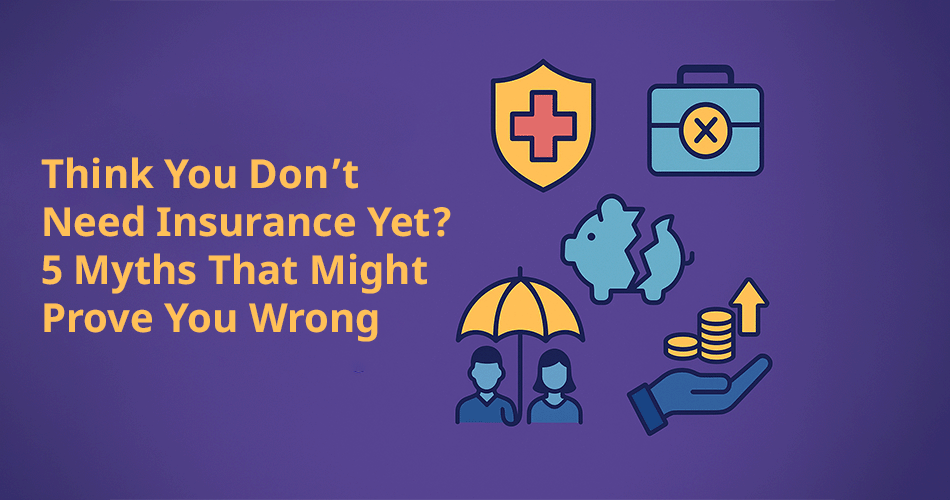
Think You Don’t Need Insurance Yet? 5 Myths That Might Prove You Wrong
The Price of Misbelief
“I’ll buy insurance later.”
“It’s too expensive.”
“My company already covers me.”
Most of us have said one of these at some point. Insurance often feels like something to think about “later,” when life becomes more predictable.
But life rarely follows a predictable script.
Unexpected events — whether medical, personal, or financial — can occur without warning. And when they do, they may create expenses that are difficult to manage through savings alone.
Still, many people postpone insurance decisions because of common myths that feel logical but may leave them financially exposed.
Imagine this: you’ve built steady savings, your career is progressing, and everything feels stable. Then a sudden medical expense arises, and a significant portion of your savings is used up quickly.
This isn’t about bad luck — it’s about being unprepared.
Insurance isn’t just paperwork or a premium. It is designed to help reduce the financial impact of unforeseen events.
Let’s look at five common insurance myths that many people believe — until experience teaches otherwise.
Myth 1: “I’m young and healthy — I don’t need insurance now.”
Reality:
Many people consider insurance only when they feel they “need” it. However, insurance is generally more accessible and affordable when purchased at a younger age and in good health.
Younger individuals are often considered lower risk by insurers, which may result in lower premiums and broader coverage options. As age increases, health risks may rise, and premiums can increase accordingly.
Think of it like buying an umbrella before it rains — planning early may offer better protection later.
Myth 2: “My employer’s insurance is enough.”
Reality:
Employer-provided insurance is a valuable benefit, but it may have limitations.
Many corporate health policies offer coverage that may be adequate for routine needs but may not be sufficient for major medical treatments. Additionally, employer coverage typically ends when you change jobs, take a break, or retire.
A personal policy offers continuity and flexibility. You can choose your sum insured, include family members, and upgrade coverage as your needs evolve.
In most cases, employer insurance works best as a supplement, not a substitute.
Myth 3: “Term insurance is a waste because there’s no return.”
Reality:
Term insurance is designed to provide financial protection to your dependents in case of an unfortunate event. It does not offer investment returns because its primary purpose is risk coverage.
For example, paying a relatively small annual premium for a large sum assured can help your family manage long-term expenses, liabilities, and goals in your absence.
Expecting “returns” from term insurance is like expecting a fire extinguisher to generate profit — its value lies in the protection it provides.
The real benefit of term insurance is the financial security it is designed to offer your loved ones.
Myth 4: “Health insurance only matters when I get old.”
Reality:
Health-related risks can arise at any age. Lifestyle factors such as stress, irregular routines, and environmental conditions have contributed to an increase in lifestyle-related illnesses among younger individuals.
Buying health insurance early may offer two key advantages:
Health insurance is often viewed as a long-term protection tool — the earlier you start, the more prepared you may be.
Myth 5: “I don’t need insurance because I already have enough savings.”
Reality:
Savings are important, but they may not always be sufficient to handle large, unexpected expenses.
A major medical event, accident, or critical illness can sometimes lead to significant costs. Insurance is designed to help reduce the financial burden of such events, allowing your savings to remain available for long-term goals like education, home purchase, or retirement.
For example, if someone has saved ₹10 lakh and faces a medical bill of ₹7 lakh, a large portion of their savings may be used. With adequate health insurance, such expenses may be covered as per policy terms, helping preserve savings for future needs.
Insurance and savings complement each other — one helps build wealth, the other helps protect it.
The Reality Check: Aarav’s Story
Meet Aarav, a 32‑year‑old professional from Pune. He had savings, SIPs, and a stable job. But he believed, “I’m young and fit — I’ll buy insurance later.”
In 2021, he faced a sudden lung infection. His hospital bill was ₹6.8 lakhs. His employer’s health plan covered ₹2 lakhs, and the remaining amount had to be paid from his savings.
He later reflected:
“I didn’t just spend money — I spent years of effort that went into building it.”
Had Aarav purchased a personal health insurance policy earlier, it might have reduced the financial impact of the situation.
His takeaway was simple:
“You can plan your life, but you can’t plan life itself. Insurance helps protect that plan.”
Conclusion: Protection Isn’t a Choice — It’s a Responsibility
Insurance isn’t about predicting the future — it’s about preparing for it.
It is not merely an expense; it is a financial tool designed to help manage the impact of unexpected events.
The myths we tell ourselves — “I’m too young,” “My job covers me,” or “It’s too costly” — may feel comforting, but they can leave us unprepared when life takes an unexpected turn.
When you buy insurance, you’re not buying paperwork — you’re choosing financial preparedness, continuity, and stability.
Investments help you build wealth.
Insurance helps you protect it.
This content is for educational purposes only and is not intended as advice or solicitation to purchase or sell any insurance product. Insurance is a subject matter of solicitation. Please read all policy-related documents carefully before deciding. This blog should not be treated as investment advice or a recommendation. Mutual Fund investments are subject to market risks. Read all scheme-related documents carefully.
We are Distributors of Financial Products in India & NOT the Investment Advisors as per SEBI guidelines.
Mutual Fund Investments are subject to market risks. Please read all offer documents carefully before investing. There is NO Guarantee of any Returns in the Mutual Fund products.
Shop 04, Sitaladevi Temple Bldg,
110. L. J. Road, Mahim,
Mumbai - 400016
Maharashtra, India
(M) 91 9820489538
(M) 91 9819656532
(M) 91 9082248525
Copyright 2020 © Om Investments. All rights reserved.
Risk Factors – Investments in Mutual Funds are subject to Market Risks. Read all scheme related documents carefully before investing. Mutual Fund Schemes do not assure or guarantee any returns. Past performances of any Mutual Fund Scheme may or may not be sustained in future. There is no guarantee that the investment objective of any suggested scheme shall be achieved. All existing and prospective investors are advised to check and evaluate the Exit loads and other cost structure (TER) applicable at the time of making the investment before finalizing on any investment decision for Mutual Funds schemes. We deal in Regular Plans only for Mutual Fund Schemes and earn a Trailing Commission on client investments. Disclosure For Commission earnings is made to clients at the time of investments. Option of Direct Plan for every Mutual Fund Scheme is available to investors offering advantage of lower expense ratio. We are not entitled to earn any commission on Direct plans. Hence we do not deal in Direct Plans.
AMFI Registered Mutual Fund Distributor – ARN-3069 | Date of initial registration – 13th Feb 2003 | Current validity of ARN – 22 Oct 2028
Grievance Officer- sebi@sebi.gov.in / asksebi@sebi.gov.in
Important Links | Disclaimer | Disclosure | Privacy Policy | SID/SAI/KIM | Code of Conduct | SEBI Circulars | AMFI Risk Factors